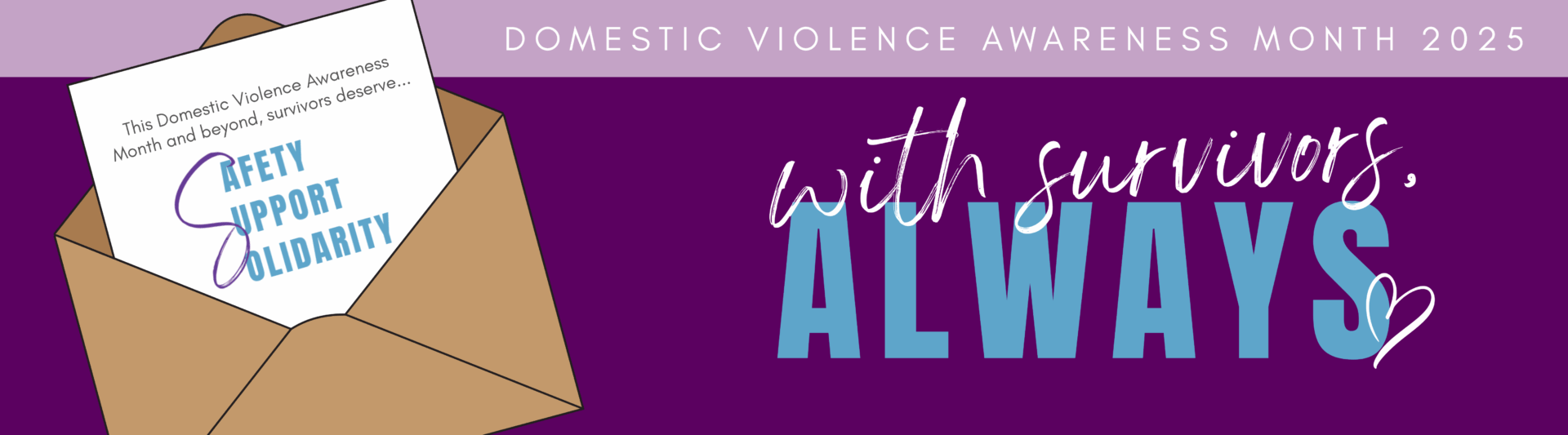
October is Domestic Violence Awareness Month (DVAM), a national campaign dedicated to raising awareness about domestic violence. Every October, organizations and individuals unite across the country to uplift the needs, voices, and experiences of survivors. In partnership with the Domestic Violence Awareness Project (DVAP), we build on the 2025 DVAM theme, With Survivors, Always.
With Survivors, Always
For DVAM 2025 and beyond, we commit to showing up for survivors, always.
- Survivors deserve safety: When we advocate for survivors’ safety, we must consider all that safety encompasses: physical, emotional, spiritual, and financial. Survivors have a right to live in homes, workplaces, neighborhoods, and institutions that are free of violence.
- Survivors deserve support: Living through and healing from trauma can be a lifelong journey. And new threats to their safety can resurface trauma reactions in profound ways. Survivors are deserving of support and care at all stages of their lives as they navigate both these echoes and emerging new threats.
- Survivors deserve solidarity: Nobody should have to stand alone in the face of hardship. Community connectedness is critical to effective advocacy. We must continue to show up for survivors, no matter what.
If you or someone you know needs help, please call our 24/7 Toll-Free Domestic Violence Hotline: 1-877-633-1112
What is Domestic Violence?
Domestic violence is a pattern of behaviors used by one partner to maintain power and control over another partner in an intimate relationship. This can manifest in different ways, including physical, emotional and financial abuse and stalking. The severity of violence is often greater in cases where the pattern of abuse was established in adolescence.
Domestic violence is prevalent in every community:
- About 2 in 5 women (41.0%) and 1 in 4 men (26.3%) in the U.S. have experienced intimate partner violence or stalking and reported an IPV-related impact in their lifetime (CDC).
- Teen dating violence is common. About 1 in 12 high school students have experienced physical dating violence (CDC).
- Women who experienced Intimate Partner Violence in the last year had almost four times the odds of reporting housing instability than women who did not experience Intimate Partner Violence (PubMed).
How CRC is Addressing Domestic Violence
Intervention
Our goal is to provide safe shelter and resources to those requiring support in the following ways:
- 24/7 Domestic Violence Hotline: 1-877-633-1112
- Emergency Shelter – Carol’s House
- Transitional Housing
- Case Management and Legal Advocacy
- Therapeutic Children’s Center
- Rental Assistance
- Counseling
Education & Prevention
Our goal is to raise awareness about the harm caused by domestic violence and teach safe and healthy relationship skills to youth and adults in schools, community groups and professional settings through:
- 40-Hour and 4-Hour Domestic Violence Advocate Training Course
- CRC-hosted events
- Workshops and presentations
How You Can Get Involved
We believe that everyone has the power to make a difference. Whether you’re supporting a friend, family member, or your community, here are four impactful ways to help survivors on their path to healing, not just during this important month, but all year round.
1. Educate Yourself & Your Community
- Learn more about domestic violence, including the types of abuse, warning signs and how to create protective environments at home, work, and in the community.
- Share what you learn with your social circles to foster awareness and empathy. The more we know, the better equipped we are to support those in need.
- Invite CRC’s educators to present workshops on healthy relationships. Learn more
- Try our empathy exercise to dive deeper into what leaving is like for individuals experiencing domestic violence.
2. Support Survivors
- As we unite to raise awareness, it’s important to remember that healing from domestic violence is often a long and challenging journey.
- One of the most powerful things you can offer a domestic violence survivor is support. Here are some ways to support a survivor:
- Create a safe space for them to share their experiences without fear of judgment or blame.
- Let them express their feelings while validating their emotions.
- Many victims feel isolated and unheard; your willingness to listen can make a significant difference in their healing journey.
- Help them create a safety plan. (Source: National Domestic Violence Hotline)

3. Participate in DVAM 2025 Activities
- Join the National Call for Unity on social media using the hashtags: #WithSurvivors, #DVAM2025, and #CallforUnity.
- Creat protective environments at schools, workplaces and neighborhoods: Invite CRC’s educators to present educational workshops for your school or community group.
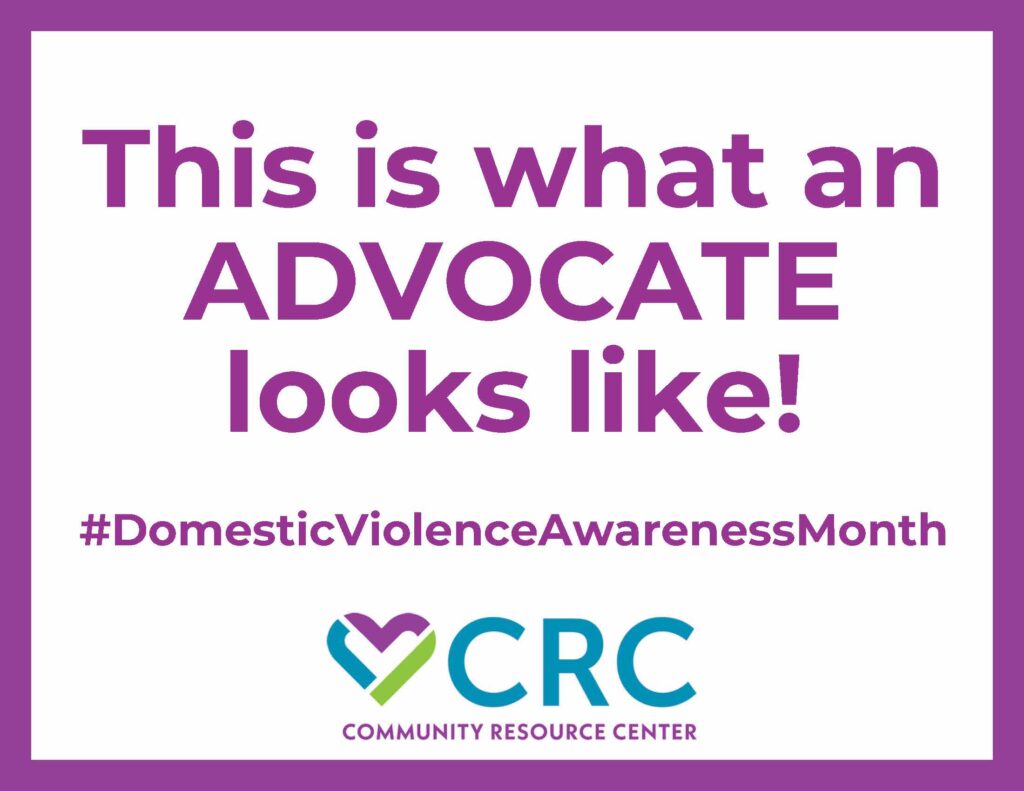
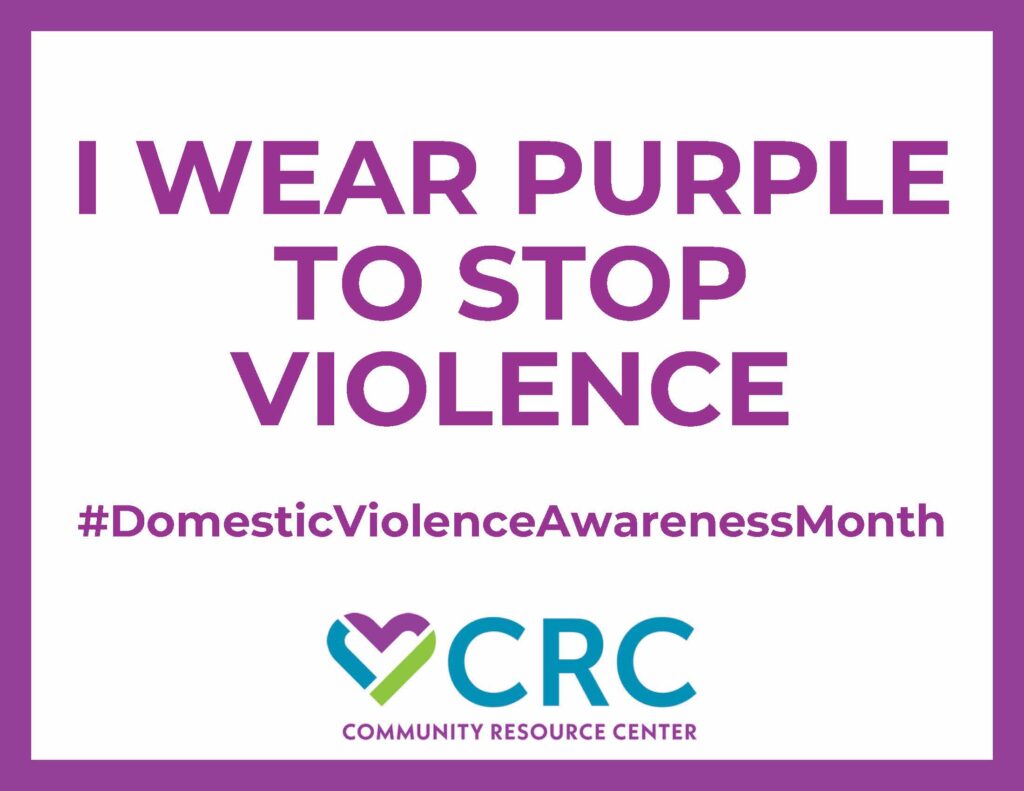
- Share photos: On Purple Thursday, October 16, or any day this month, share photos of you wearing purple or holding an awareness sign.
Awareness Signs (Click the images to download):
4. Make a Gift:
- Donate to CRC to help our efforts to prevent domestic violence and help survivors of domestic violence.
- Donate items to support our emergency shelter and food pantry.
Events
#PurpleThursday
October 16, 2025: Wear purple to show your support for domestic violence survivors and commitment to ending abuse.
Relationship Awareness Workshops
October 22, 2025, 7:00 – 8:00 PM: Wellbeing Wednesday Love Immersion Workshop
Register to attend Community Resource Center’s workshop series about self-love, healthy boundaries, and positive patterns and behaviors, designed to uplift your life.